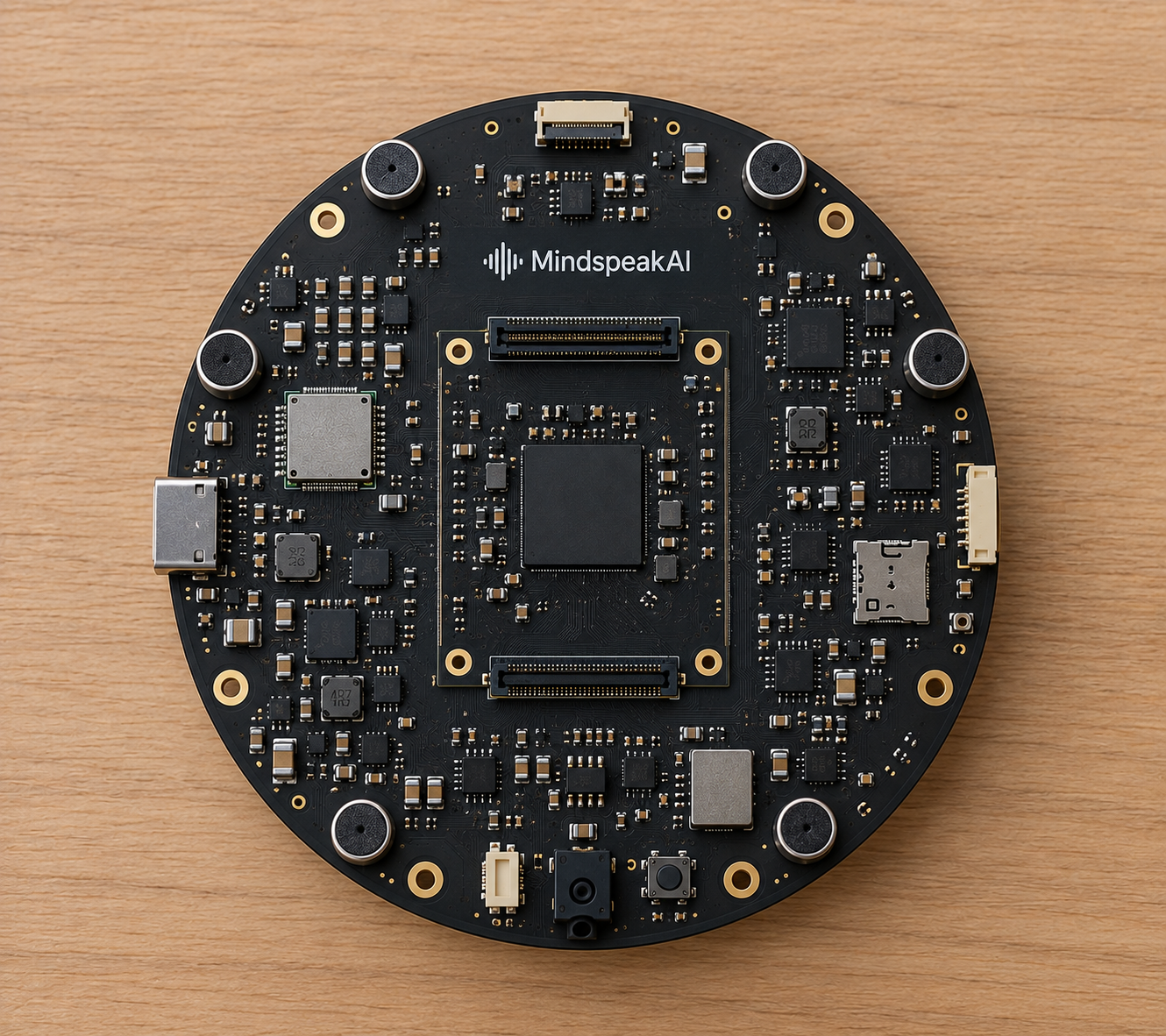
MINDSPEAK BASEBOARD
┌───────────────────────────────────────┐
│           4 × MEMS MIC                │
│                 ▼                     │
│          ┌─────────────┐              │
│          │   XVF3800   │              │
│          │  AUDIO DSP  │              │
│          └──────┬──────┘              │
│             I2S / USB                 │
│                 ▼                     │
│  ┌──────────┐       ┌──────────────┐  │
│  │ ESP32-S3 │◄─────►│   COMPUTE    │  │
│  └──────────┘       │ MODULE SLOT  │  │
│                     └──────────────┘  │
│          LEDs, Sensors, UI            │
│                 ▼                     │
│ Compute Audio ──► DAC ──► AMP ──► SPK │
└───────────────────────────────────────┘
MindspeakAI Baseboard V1
Open-Source AI Companion Architecture
The Mindspeak baseboard is designed around one core principle: It acts as a complete voice-assistant peripheral system, while the plug-in compute module remains replaceable. It functions independently with cloud AI, but instantly becomes a powerful local-AI device when a compute module is attached.
Coming Soon1. Audio Frontend
- Microphones: 4 × digital MEMS microphones (PDM interface) arranged symmetrically with individual test points. Acoustic isolation ensures the microphones are kept away from the speaker area.
- XMOS XVF3800 DSP: Dedicated audio processor for AEC, beamforming, noise suppression, dereverberation, AGC, VAD, and DoA far-field voice capture.
- Audio Output: I²S DAC feeding a 5–10W Class-D amplifier with a critical AEC reference path back to the XVF3800.
2. Embedded Controller
- ESP32-S3: ESP32-S3-WROOM-1-N16R8 (16 MB Flash, 8 MB PSRAM) acting as the always-on embedded controller.
- Responsibilities: Handles Wi-Fi, BLE, OTA, button inputs, LEDs, sensors, power management, hardware status, and fallback assistant functionality.
- User Interface: Action/wake, Volume +/-, and Hardware Microphone Mute buttons. A circular 360-degree RGB LED ring visually indicates states (listening, thinking, speaking).
3. Compute Module Interface (MCM)
- The Mindspeak Compute Module: An open, high-density board-to-board interface designed to accept adapters for Raspberry Pi CM5, Jetson, NPUs, or custom AI accelerators.
- High-Speed Connectivity: PCIe x1, USB 3.x, USB 2.0.
- Audio & Control: I²S (TX/RX, MCLK, BCLK, LRCLK), UART, I²C, SPI, GPIO, RESET, WAKE.
- Media & Power: MIPI CSI-2, MIPI DSI, and dedicated 5V/3.3V high-current rails.
4. Power & Expansion
- Power System: USB-C PD with derived rails for ESP32 (5V), digital logic (3.3V), AI compute module, and Class-D amplifier.
- Sensors: Baseboard includes ambient light, temperature, and humidity sensors. Expansion connectors provided for mmWave, PIR, and ToF.
- Hardware Mute: A physical switch directly controls hardware microphone mute, bypassing software limits.
- Debugging: ESP32 JTAG, XMOS XSYS2/XTAG4 debug header, and UART console for complete developer access.
What You Can Build
Private Home Assistant
Build a fully offline smart home satellite for Home Assistant. Issue commands, control lights, and monitor the room environment with completely private, on-device voice processing.
Local LLM Companion
Attach a powerful compute module to run smaller LLMs entirely on the edge. Create a personalized AI companion that talks to you without sending your audio to the cloud.
Smart Sensor Hub
Utilize the onboard temperature, humidity, and ambient light sensors, or plug in a mmWave radar module to detect human presence, turning the dev kit into a powerful environmental node.
Visual Assistant
Connect a camera via the MIPI CSI-2 interface and use a Vision-Language Model (VLM) on your compute module to build an AI that can see, read text, and identify objects in real-time.
Multi-Room Audio
Leverage the high-quality XMOS audio pipeline, I²S DAC, and 25W amplifier output to build networked smart speakers that sync perfectly across your home.
Custom AI Hardware
Design your own specific adapters for the MCM interface. Whether it's a dedicated Neural Processing Unit (NPU) or specialized robotics controllers, the baseboard is your foundation.